Tool reconditioning
If the tool is coated, we first strip the coating from the tool. Then, together with you, we assess how the tool should be reconditioned.
 Before
 After
Removing the existing coating
The coating removal process is needed to remove worn coatings before we apply our PVD coating to your tools or components. Removing the old coating allows better adhesion of the new PVD layer. Either chemical stripping or, in rare cases, mechanical stripping can be used.
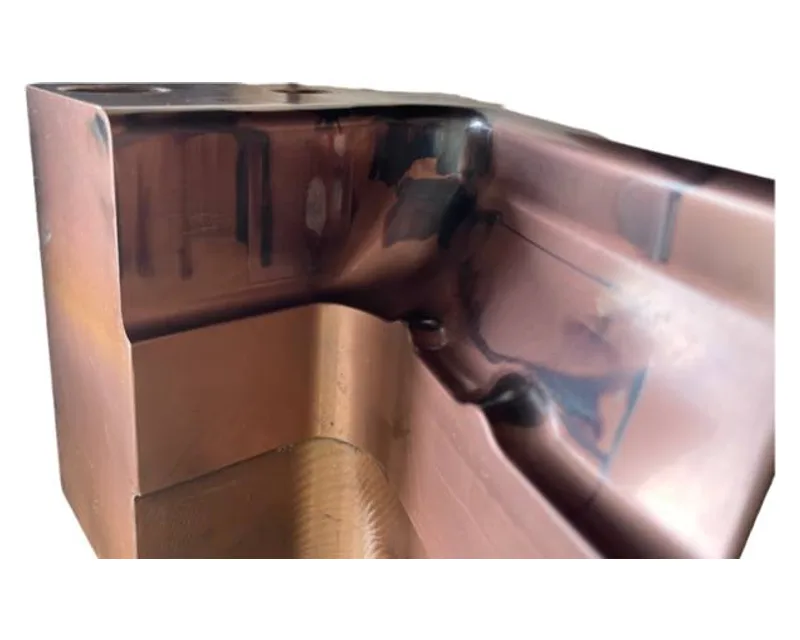 Before
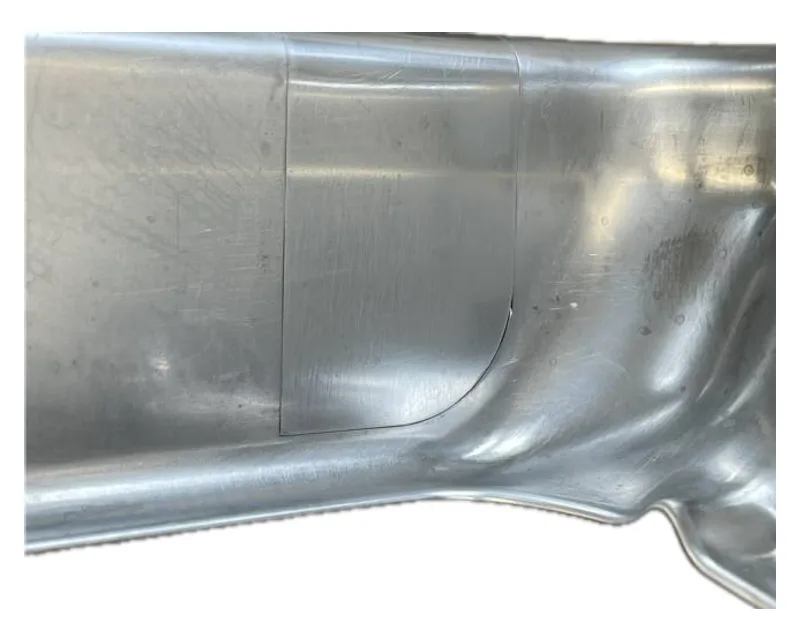 After
We can remove the following layers from your tool:
| Layer | Substrate |
|---|---|
| TiN/ | Tool steelHSSHM |
| TiAlN/ | Tool steelHSSHM |
| DLC | Tool steelHSSHM |
| CrN | Tool steelHSS |
Recoating
We can return the tool to you so that you can recondition it yourself and then send it back to us for recoating. If the tool has no major damage that could change the geometry of the product after reconditioning, we also offer complete reconditioning of the tool on our premises (welding, polishing and measurement of geometric tolerances).
After the worn coating has been removed, we can use laser welding and polishing to the required level of gloss and roughness to bring your tools back into a condition for producing quality products again.
Removal of the remaining coating and impurities
Decoated tool
Tool repair: grinding, laser welding, polishing
Repaired tool
PVD coating
Tool with PVD coating
The sustainability potential of PVD coatings
The use of coated tools has many advantages. PVD coatings allow faster material flow, as they reduce friction between the tool and the workpiece. They provide thermal insulation and a chemical barrier, thereby preventing physical and chemical reactions at the surface.
They increase wear resistance, thereby extending tool life, and allow higher machining parameters. They give tools a nicer appearance and make wear easy to monitor (different colour).
Their environmental and economic contribution is also important: a clean and environmentally acceptable technology, lower material and energy costs, higher productivity, longer service life and savings.
Read the full article: Towards more sustainable operations with measuring technology and PVD coating (opens in a new tab) (in Slovenian)
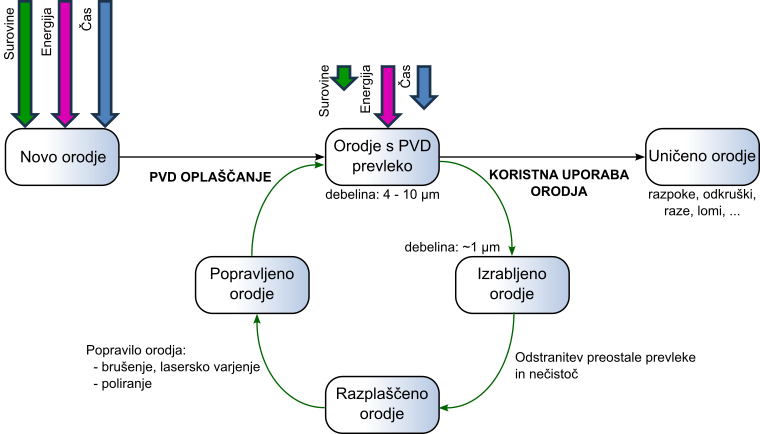
Smart tools, even more sustainable
The employees are aware that the synergy between coating and metrology is essential for the sustainable use of a tool. The key challenge is to stop tool wear just before permanent and irreversible damage, which would not be possible without advanced measuring methods.
During operation, the condition of the tool and the extent and nature of the wear are monitored. With smart tools, sensors in/on the tool itself and in its immediate vicinity are a great help here.
How the condition of the tool is monitored during operation:
Visual inspection of the (smart tool's) surface with machine vision.
Temperature with thermal imaging cameras.
Coating thickness with optical fibres.
Noise and vibration with MEMS accelerometers.